Motivated lighting
Also calledJustified lighting, Source-motivated lighting
Motivated lighting is a lighting approach in which every light in a scene appears to come from a source the viewer can see or logically infer, such as a window, a lamp or a streetlight. It keeps the audience inside the story world by hiding the crew's craft behind a believable, real-world reason for the light.
What it tells
Directors reach for motivated lighting when they want the audience to trust the space without thinking about it. Because the light seems to come from something in the room, the scene reads as lived-in rather than staged, and mood can shift with the story (a lamp switched on, a door opened to sunlight) instead of an unexplained lighting change. It lets light carry character and atmosphere while staying invisible as a technique.
How it is shot
The gaffer first identifies the scene's apparent sources: a table lamp, a window, a neon sign, a candle. Real film lights are then placed to match that source's color temperature, direction, height and falloff, often hidden just outside frame or bounced off a nearby wall. A lamp key might be a small fresnel with an amber gel set at the lamp's height; a window key is usually an HMI outside, diffused and matched to the time of day (5600K for midday, warmer for sunset). Negative fill, kickers and bounce cards are added but styled to look like natural falloff. Continuity is checked shot to shot so light direction and color stay consistent as actors or camera move near the source.
When to use it
- When a scene needs to feel grounded and real, with every light explained by something visible in frame.
- Interior scenes with lamps, candles or screens where light should shift naturally as characters move near them.
- Day-to-night or window-lit exteriors where sunlight or streetlight has to look continuous and believable.
- Dialogue scenes where mood should come from the world itself, not from an obvious lighting rig.
Not to be confused with
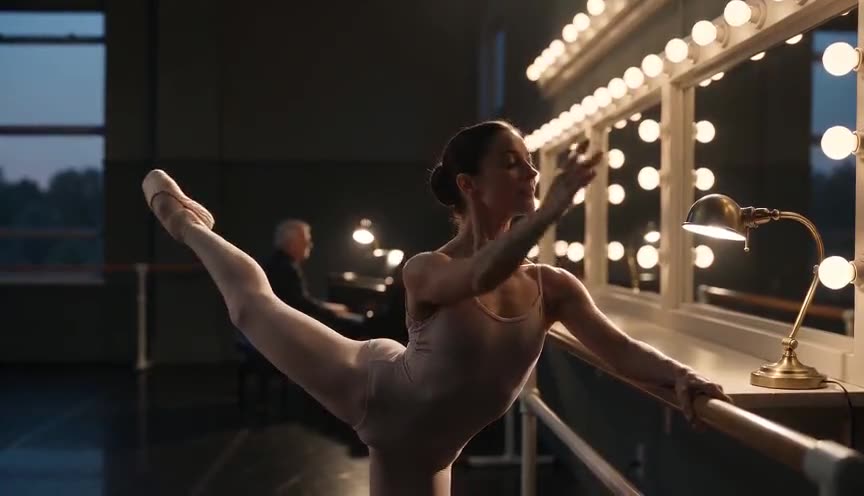
Practical lighting uses actual visible fixtures (lamps, neon signs) as sources in frame. Motivated lighting is the broader principle: hidden film lights are shaped to match those practicals, or an implied source, so the whole setup reads as justified.

Available light means shooting with only the light that already exists, adding nothing. Motivated lighting often adds real film lights, but disguises them so they appear to come from the same source as the available light.
In film
The Godfather (1972)
Gordon Willis lights interior scenes as if the only source were the visible desk or overhead lamps, creating deep, source-justified shadow on faces.
Barry Lyndon (1975)
Candlelit interiors use practical candles and ultra-fast lenses, making the visible flames the credible source for the scene's warm, low-level illumination.
The prompt
Name the visible source out loud (lantern, window, neon sign, candle) and describe its color, direction and falloff on the subject. Say where the light is warm, where it turns cool or dark, and keep any added fill described as if it came from the same source. Avoid mentioning studio lights, softboxes or rigs, since naming visible sources is what makes the model render believable, story-justified light instead of flat, generic illumination.
The exact prompt that rendered the video on this page. Keep the description of the move, change the subject and the setting.
Motivated lighting: a static shot along a narrow Venetian canal at night, water reflecting warm amber light from a row of hanging lanterns on a stone bridge and cool blue light spilling from a tall arched window above a doorway. A gondolier in a dark jacket rows slowly through the frame, his face and the boat's wake lit only by these two visible sources, warm on one side, cool on the other, with soft falloff into shadow beyond their reach. The camera holds completely still, lanterns flicker faintly. No text.
Common mistakes
Light from nowhere
Adding a light that does not correspond to any visible or implied source in the scene breaks the illusion and pulls the viewer out of the story.
Mismatched color temperature
Lighting a scene motivated by a warm lamp or candle with cool, daylight-balanced light makes the source and the lighting visibly disagree.
No falloff
Keeping the whole frame evenly lit instead of dimming with distance from the source removes the sense that light is actually coming from that point.
Frequently asked questions
What is motivated lighting?
Motivated lighting is lighting a scene so that every light appears to come from a source visible or implied within the story, like a lamp, window or streetlight, rather than from an unexplained studio setup.
How is motivated lighting different from natural lighting?
Natural lighting simply uses what exists (usually sunlight). Motivated lighting can add real film lights, but shapes them to match a visible or implied source's color and direction, so the added light still looks natural.
Do you need real practical lights on set for motivated lighting?
Not always. A source can be implied, like sunlight through an unseen window, as long as the direction, color and falloff of the lighting are consistent with where that source would logically be.
Can AI video tools generate motivated lighting from a text prompt?
Yes, tools like Imaginode respond well when the prompt names a specific visible source (a lantern, a window, a screen) and describes its color and falloff, which pushes the model toward believable, source-justified light instead of flat illumination.