Rembrandt lighting
Also calledRembrandt light, triangle lighting, 45-degree lighting
Rembrandt lighting is a portrait lighting setup where the key light sits about 45 degrees above and to the side of the face, leaving a small triangle of light on the cheek opposite the source, under the eye, separated from the rest of the highlight. It gives a flat face real volume and reads as moody, dignified or morally ambiguous.
What it tells
Directors reach for Rembrandt lighting when a character needs weight without melodrama. The half-lit face suggests someone holding something back: guilt, calculation, grief, authority. Because the pattern comes from painting, it carries a built-in sense of gravity and craft, so it works well for figures the story wants the audience to study rather than simply like. It flatters bone structure and turns an ordinary close-up into something the eye lingers on.
How it is shot
Position the key light roughly 45 degrees off the camera axis and 45 degrees above the subject's eyeline, so it grazes across the face instead of flattening it. The shadow of the nose should just touch the shadow under the cheekbone on the far side, leaving one small isolated triangle of light there, no bigger than the eye itself. Use a single source, often a Fresnel or a modified softbox with barn doors, with fill kept low (contrast ratio 4:1 or higher) so the shadow side stays dark but not black. A catchlight in the eye on the shadow side confirms the setup is reading correctly on camera. Turn the subject about three-quarters toward the key for the cleanest triangle.
When to use it
- A character reveals a moral gray area or a secret during dialogue
- An interrogation, confession, or quiet decision scene needs psychological weight
- A single-source practical light (window, lamp, screen glow) motivates the setup
- You want a painterly, classical portrait look inside a modern or gritty setting
Not to be confused with
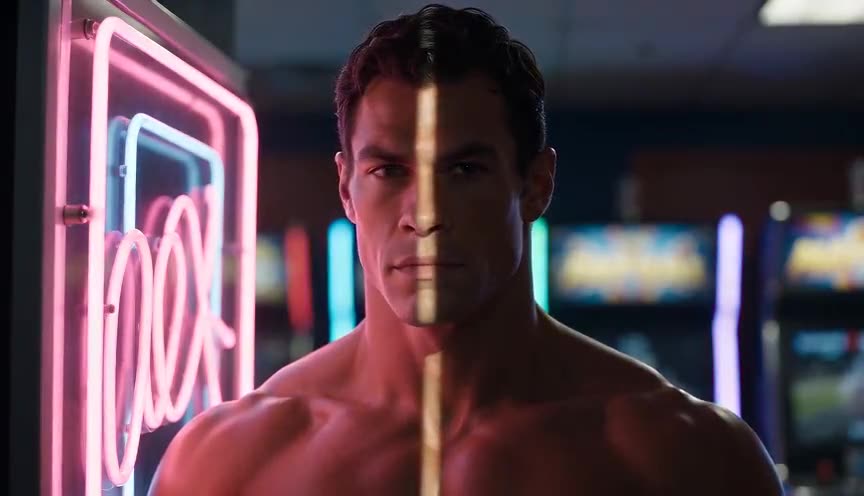
Split lighting puts the key at 90 degrees, lighting exactly half the face and leaving the other half fully dark, with no triangle. Rembrandt softens that split into a single readable highlight.
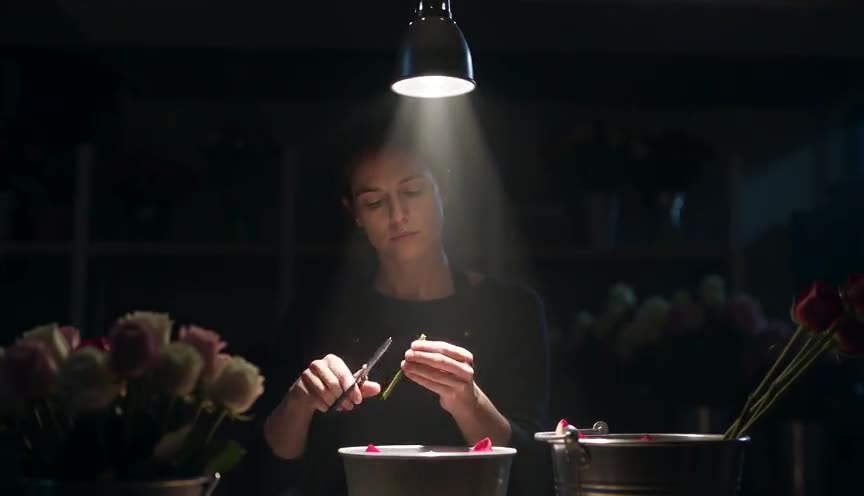
Chiaroscuro is the broader painterly principle of strong light against deep shadow across a whole frame. Rembrandt lighting is one specific face pattern that can exist inside a chiaroscuro scene.
In film
The Godfather (1972)
Gordon Willis gives Don Corleone a high side key in the office scenes, leaving deep eye sockets and Rembrandt-style cheek triangles.
Barry Lyndon (1975)
Kubrick and Alcott modeled interior faces on Dutch and Flemish portraiture, using window and candle sources to build Rembrandt-style modeling.
The prompt
Name the light's position explicitly (45 degrees above, to one side) and describe the triangle under the eye directly, since models often default to flat frontal light otherwise. Specify a single hard or semi-hard source and low fill so the shadow side stays visibly darker. Avoid vague words like 'moody' alone; anchor the look with a physical source (window, overhead fixture, lamp) so the model has something to motivate the angle from.
The exact prompt that rendered the video on this page. Keep the description of the move, change the subject and the setting.
Rembrandt lighting portrait. A bearded man in his fifties sits in a dark room in three-quarter view, a single hard light placed high and to one side. The lit side of his face is bright; the far side is in deep shadow except for a small, clearly visible bright triangle of light on the shadowed cheek, just under the eye. Pure black background, like an old master painting. He breathes and blinks, very slow push in. No text.
Common mistakes
Light too frontal
Placing the key almost straight on flattens the face and erases the triangle entirely, turning the setup into plain three-point lighting instead.
Triangle merges with the highlight
If the key is too wide or too low, the shadow of the nose never separates from the cheek shadow, and the signature isolated triangle disappears.
Fill washes out the shadow side
Adding too much fill light raises the shadow side too close to the key side, killing the contrast ratio that makes the pattern read as Rembrandt.
Frequently asked questions
What is Rembrandt lighting?
It is a portrait lighting pattern where the key light sits about 45 degrees above and to the side of the face, leaving a small isolated triangle of light on the cheek opposite the source, under the eye.
Why is it called Rembrandt lighting?
The pattern is named after the painter Rembrandt van Rijn, whose portraits often used a single strong light source to model faces with exactly this triangle of light and deep surrounding shadow.
How do you check if Rembrandt lighting is correct on camera?
Look for a small triangle of light on the shadow-side cheek, no larger than the eye, with the nose shadow just touching the cheek shadow, and a visible catchlight in that eye.
Can an AI video model generate Rembrandt lighting reliably?
Yes, if you describe the light's angle and the triangle explicitly rather than just naming the technique; tools like those on Imaginode respond better to concrete physical descriptions than to style labels alone.