Split lighting
Also calledHalf-and-half lighting, 90-degree lighting, Side split light
Split lighting is a portrait lighting setup where a single light source, placed to the side and roughly level with the subject's face, illuminates exactly one half of the face while the other half falls into shadow. It reads instantly as duality, secrecy or inner conflict, because the viewer sees two opposing versions of the same face at once.
What it tells
Directors reach for split lighting when a character is not what they seem: a liar mid-confession, a hero about to cross a line, a person torn between two loyalties. The straight line down the center of the face does the storytelling work that dialogue can't, showing the audience a visual argument between two halves of the same person. It is a shorthand for moral ambiguity that predates cinema, borrowed from stage lighting and portrait painting.
How it is shot
A single key light, often a small fresnel or a hard-edged practical, is placed at roughly 90 degrees from the camera-to-subject axis, at eye level. The subject faces the camera close to straight on, so the light grazes one cheek and never reaches the other. No fill light is added, so the shadow side reads near black, producing a lighting ratio of 8:1 or higher. A smaller, harder source gives a crisp edge down the nose and center of the face; a larger, softer source softens that edge into a gradient. In practical scenes, neon signs or single window light can double as the source.
When to use it
- Introducing a character whose loyalty or honesty is in question before they speak
- Showing an internal turning point, such as a decision to betray or confess
- Building a noir or thriller mood where secrets matter more than plot exposition
- Visualizing a literal dual nature, like a villain reveal or a split personality
Not to be confused with
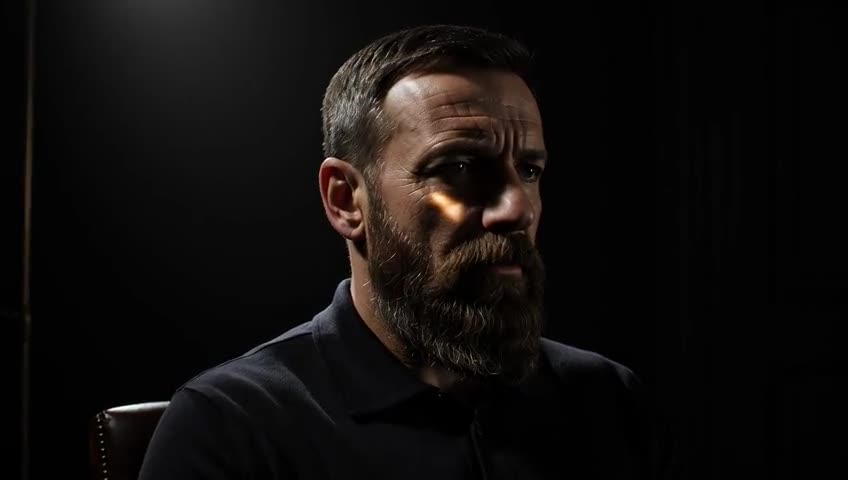
Rembrandt lighting also uses one key light but at about 45 degrees, leaving a small triangle of light on the shadow cheek. Split lighting pushes the light to 90 degrees so no triangle survives, making the division absolute rather than soft.
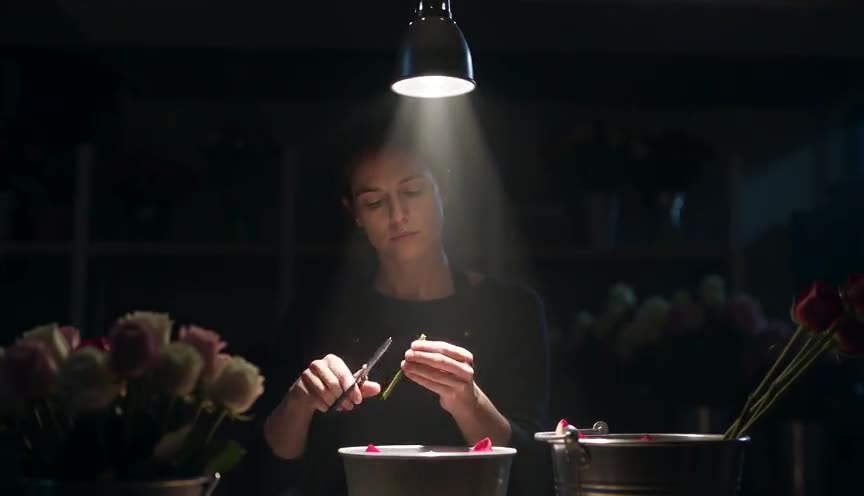
Chiaroscuro is a broader painterly style of strong light-to-dark contrast across a whole frame. Split lighting is one specific, face-level technique that can be used inside a chiaroscuro scheme but also works in otherwise flat lighting.
In film
The Dark Knight (2008)
Split lighting is used on Harvey Dent's face after his transformation, physically illustrating his split identity as Two-Face.
Psycho (1960)
During the parlor conversation with Marion, hard side light splits Norman Bates's face, foreshadowing the divided identity central to the film.
Apocalypse Now (1979)
In Kurtz's compound scenes, Vittorio Storaro often lights Marlon Brando from the side, leaving half his face black to heighten mystery and inner conflict.
The prompt
Name the light's position explicitly (from the side, at eye level) and describe the result as a hard, straight shadow line down the center of the face, not a soft gradient. Say 'no fill light' so the model does not lighten the dark half. Avoid words like 'evenly lit' or 'soft glow on both sides,' which push toward flat or butterfly lighting instead. A practical source like a neon sign or a single lamp gives the model a believable motivation for the split.
The exact prompt that rendered the video on this page. Keep the description of the move, change the subject and the setting.
Split lighting: a static medium close-up of a man in his thirties standing beside a glowing pink neon arcade sign, the light hitting his face directly from the right at eye level so a hard, straight shadow line splits his face exactly down the center, the right side lit in warm pink and the left side falling into near-black shadow, no fill light softens the dark half, background arcade cabinets glow softly out of focus, he slowly turns his head a few degrees toward camera while the shadow line stays locked to the center of his face, camera remains locked off on a tripod, lens 50mm. No text.
Common mistakes
Adding a fill light
A fill light on the shadow side lifts it and destroys the near-black contrast that makes split lighting read as duality instead of just moody side lighting.
Wrong light angle
Placing the key too far toward the camera creates broad or short lighting with a soft transition, not the clean 90-degree split down the center of the face.
Soft source, no edge
A large diffused softbox blurs the shadow line into a gradient. Split lighting needs a small or hard-edged source to keep the boundary crisp and readable.
Frequently asked questions
What is split lighting?
Split lighting is a lighting setup where one side of a subject's face is fully lit and the other falls into shadow, with a single light placed to the side at eye level. It is used to suggest duality, hidden motives or inner conflict.
How is split lighting different from Rembrandt lighting?
Rembrandt lighting sits at about 45 degrees and leaves a small triangle of light on the shadow cheek. Split lighting moves the source to 90 degrees, removing that triangle so the face is divided cleanly in half.
Why do filmmakers use split lighting for villains or conflicted characters?
The visual split mirrors a psychological split. Audiences read half-lit, half-dark faces as a sign that the character is hiding something or fighting an internal battle, without needing a line of dialogue to explain it.
Can I generate split lighting with an AI video tool?
Yes. Describe the light's exact position (from the side, eye level), state there is no fill light, and ask for a hard straight shadow line down the center of the face. On Imaginode you can test this prompt directly and adjust the light color or angle to fine-tune the split.