A classroom bingo for the last day of term
For a class of 25 pupils, plan at least ten different cards and have them play in pairs. Replace the words with the Christmas vocabulary seen in class, in French or Spanish if it is a language lesson.
A printable Christmas bingo: sixteen named pictures for little ones, or twenty-four words and a free space for the family. Text right on the demo, 6 credits.
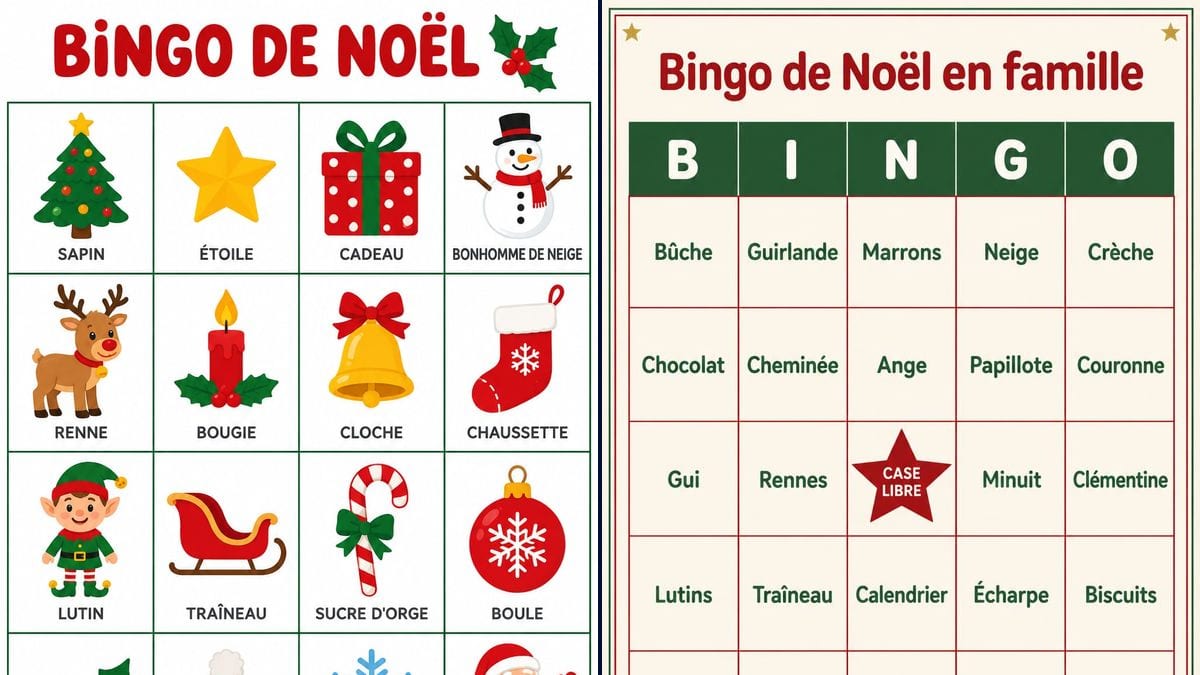
Real workflow, no input photo: a sixteen-square card with a drawing and its name in each, from the tree to Father Christmas, under the title "BINGO DE NOËL", then a cream twenty-five-square word card under the letters B, I, N, G, O, with "CASE LIBRE" in the centre. The demo is in French and every word is right.
At a glance
A Christmas bingo keeps the whole table busy for an hour, from toddlers to grandparents. All it takes is one card per player, something to mark the squares (sweets, buttons, dried pasta) and someone to draw. This workflow makes the cards, ready to print.
It gives you two designs. The first, with pictures, lines up sixteen drawings with their name written underneath, for children who cannot read yet. The second has twenty-four Christmas words and a free space in the centre, under the letters B, I, N, G, O. On the demo, written in French, GPT Image 2.5 Sunburst spelled every word right on the first try, accents included. Its limit: it makes one card at a time, and every player wants a different one.
For the rest of the holidays, see the printable Advent calendar, the gift tags and the Christmas menu. Both cards cost 6 credits, see pricing.
These are the files of the workflow above, exactly as the models produced them, unretouched. The starting point is shown when there is one.
Render
Parents and grandparents preparing a game for Christmas Eve or Christmas afternoon, teachers and youth leaders who want a game for the last day of term, big families looking for an activity that mixes ages.
The list of words or pictures, each in quotes and in square order, the title, the grid size and whether there is a free space. No photo.
Choose your words or pictures
Sixteen squares for little ones, twenty-five for older players, free space included. Pick things everyone at the table knows, and avoid two words that sound too alike.
Write them in quotes, in order
The prompt lists every square, row by row. Replace the words with yours without removing the quotes: that is what stops the model from inventing any.
Rerun for each player
Change the order of the words in the prompt and rerun: you get another card for 3 credits. Six players, six cards, about 18 credits.
Prepare the caller's list
Write every word on a slip of paper and put them in a hat. The caller draws, reads aloud, and for little ones points to the drawing on their own card.
The same canvas, tuned for different needs: each variation is two or three lines of prompt away.
For a class of 25 pupils, plan at least ten different cards and have them play in pairs. Replace the words with the Christmas vocabulary seen in class, in French or Spanish if it is a language lesson.
Sixteen squares is already a lot at 3. Ask for "3 columns by 3 rows" and only nine drawings: the game goes faster and the drawings are bigger. Not tested on the demo.
Replace the objects with what happens at every Christmas dinner: "Uncle talks politics", "Someone spills a drink", "Blurry group photo". Everyone ticks a square when it happens, no caller needed. Keep the phrases short, three or four words per square.
Ask for "black line drawings on a white background, no colour". Children colour their card before playing, and printing uses less ink. The colouring Advent calendar follows the same idea.
Run a third image with the same sixteen drawings, each in its own card separated by dotted lines, and the title "CALLING CARDS". Cut them out, shuffle them in a hat, and little ones can draw by themselves.
Keep the word card and change the list: "Champagne", "Fireworks", "Resolutions", "Midnight", "Party poppers". The title becomes "New Year Bingo". The prompt and the checks stay the same.
Every player gets bingo on the same call, and the game ends at once. You need a different card per player, or at least per team.
"Star" and "Stars", "Tree" and "Pine": read aloud, players mix them up. Keep words nobody can mix up when they are read out.
Without the full word list, the caller draws blind and may call a word that is on no card at all. Keep the starting list next to you.
On the demo, yes: the sixteen names on the picture card and the twenty-four words on the family card are right, accents and apostrophe included. Still read every square before printing, especially if you change the words.
Rerun the node with the words in a different order in the prompt, or swap three or four words for others. Each rerun costs 3 credits. Keep the same starting list so the caller can draw everything.
The picture card works from 3 or 4, with an adult showing the drawing that was called. The word card needs reading, around 7, and works very well with adults.
3 credits per card on GPT Image 2.5 Sunburst at medium quality, 6 for the two on the demo. One more card for another player costs 3 credits.
The word card is 1055 x 1491 pixels, the shape of an A4 sheet: about 180 dots per inch at A5, and around 127 at A4 or Letter, still readable for large words. The picture card is 1024 x 1536 pixels, a little taller: on A4 it keeps a thin white margin on the sides.
Yes, and it is handy for playing again every year. Mark the squares with a dry-erase pen, or with counters, buttons or sweets.
No. The model works from the prompt alone. If you want your own drawing in a square, plug an image into the node, but the demo did not test it.
Yes, write the words in the language you want, in quotes. The demo is in French and Sunburst writes English just as well; for a language with another alphabet, check every square with someone who reads it.
Make a printable Christmas bingo with AI
Use this workflowFree account, no card required. The workflow opens pre-filled in your canvas.
 GPT Image 2.5 Sunburst
 Nano Banana 2.1
 Recraft V4.1