The clue in a crime film
In the short, the detective finds a card from Kerrec among the missing man's things. The short message and the one-letter signature set off the plot, and the camera lingers on the postmark.
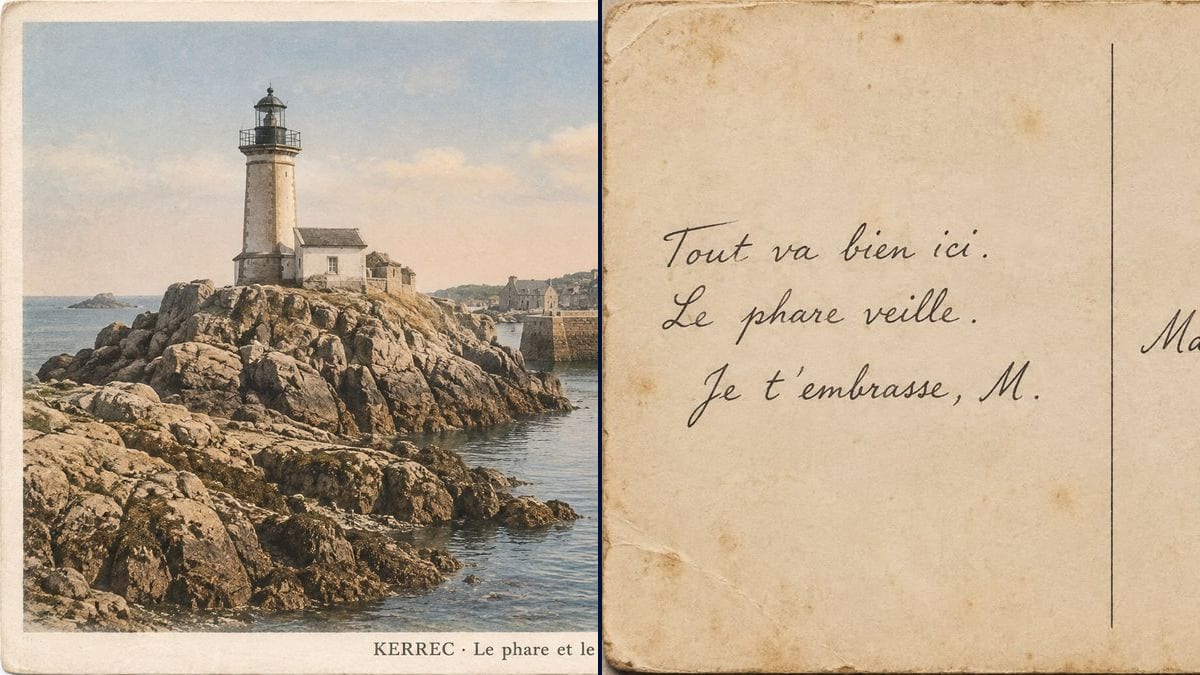
The hand-coloured front and handwritten back of a 1930s postcard, message and address spelled right, ready to print for a close-up. Workflow visible here, no account needed.
Real workflow: the hand-coloured front "KERREC · Le phare et le port" with a lighthouse on the rocks and boats at anchor, then the yellowed back with a message signed M., Hélène Keane's address in Saint-Malo, a lighthouse stamp and the postmark "KERREC 1934". The card is in French.
At a glance
The postcard a character turns over in their fingers often carries a clue: a place, a date, a signature. Flea markets have old postcards, rarely one of the invented island in your script, and never with the right message. This workflow gives you the front and back of the same 1930s card, ready to print for an insert shot.
The hard part is making both sides match and keeping the message readable. The prompt sets the period, the colouring process and the layout of the back, and gives every text in quotes. Sunburst writes the caption, message, address and postmark letter for letter; the handwriting is a little too even.
For a full letter, see the vintage letter prop; for the paper lying next to it, the fake newspaper. Both sides cost six credits.
These are the files of the workflow above, exactly as the models produced them, unretouched. The starting point is shown when there is one.
Render
Props teams, production designers, period film directors, authors, AI filmmakers and escape room designers.
The place and period, what the front photo shows, and the message, address and postmark in quotes.
Pick the place and period
The name of the place, what the photo shows, the decade. A 1900s card and a 1950s card have neither the same colours nor the same postmarks.
Write a short message
Two or three sentences, like a real card, with a signature. It's what the camera reads in close-up, so put it in quotes.
Give the address and postmark
The recipient's name and town, then the place and year on the postmark: they have to match the front and the story.
Print both sides
On heavy card at postcard size, about 9 x 14 cm, after the Enhance node. Age the corners by hand to finish.
The same canvas, tuned for different needs: each variation is two or three lines of prompt away.
In the short, the detective finds a card from Kerrec among the missing man's things. The short message and the one-letter signature set off the plot, and the camera lingers on the postmark.
A 1930s film follows a family split between the island and the mainland. The props team makes one card per stage of the story, same island, different messages and postmarks, for the insert shots.
A self-published author slips a card from her novel's island into the copies she sends to reviewers. The back carries a line from the book, signed with the character's initial.
An AI filmmaker wants an insert of a card held in a hand. He generates both sides first, then uses them as references so the text stays the same between the wide shot and the close-up.
A lighthouse-themed escape room hides a postcard in a drawer. The year on the postmark gives the padlock code, and the message points the players to the next room.
An actress reads a card aloud during the play. The prop, printed front and back on heavy card, survives being handled night after night, and the audience sees the lighthouse on the front.
A postcard holds three lines. A long text becomes unreadable, the model is more likely to slip, and it stops looking like a period card.
A 1952 postmark on the back of a 1930s card, or a stamp that has nothing to do with the place: someone will notice. Keep the same place and year in both prompts.
A card that bends in the hand shows immediately on screen. Print on 300 gsm card or heavier, then age it.
Stick to an invented place, stamp and postmark. Copying a real stamp or a real cancellation goes beyond what a set prop needs.
In the demo, yes: the caption on the front and the message, address and postmark on the back are exact, accent on "Hélène" and middle dot included.
Not quite: it's readable but very even, like a script font. For a very tight shot, have someone on the crew copy the message with a dip pen onto a back printed without it.
Because the prompt bans any other word. Real cards from the period often carry that heading and the stamp's value: add them in quotes if the shot shows them.
Six credits, three per side on GPT Image 2.5 Sunburst at medium quality. A second card, with another message or year, costs six more for both sides.
Because it spells correctly, readable cursive included, and it's the cheapest model in the catalogue. On the yellowed card in the demo, a light background, it didn't get a single word wrong.
Landscape 3:2, 1536 x 1024 pixels, very close to the proportions of a 9 x 14 cm card. Go through the Enhance node before printing.
Yes: change the format in the node and describe a vertical front, a church, a street, a woman in a traditional headdress. The back stays landscape.
Yes, that's what a real cancellation does: the round postmark bites into the edge of the stamp and wavy lines run across it. In the demo, the stamp touches the last letter of "KERREC", which stays readable.
Make a vintage postcard film prop with AI
Use this workflowFree account, no card required. The workflow opens pre-filled in your canvas.
 GPT Image 2.5 Sunburst
 Nano Banana 2.1
 Recraft V4.1