Key light
Also calledmain light, primary light, principal light
The key light is the primary light source in a shot, the one that establishes direction, intensity and the main shadow pattern on a subject. It sets the base exposure and mood of a scene before any fill, backlight or other source is added.
What it tells
Directors treat the key light as the storytelling engine of a shot, because its angle and hardness tell the audience how to feel about a face before a word is spoken. A low, hard key reads as threat or interrogation, a soft key from above reads as warmth or safety. Choosing where the key comes from, and why it would plausibly be there, is often the first creative decision on set.
How it is shot
On set, the key is usually the brightest source, placed 30 to 45 degrees off the camera-subject axis and slightly above eye level, though placement shifts for effect. Gaffers set its output first, then meter fill and backlight as ratios against it (a 2:1 or 4:1 ratio is common for dramatic contrast). Hardness depends on source size relative to the subject: a bare HMI or small fresnel from several meters away throws hard, defined shadows, while a large bounced or diffused panel close to the face gives soft, wrapping light. Color temperature, distance and modifiers (flags, nets, scrims) all shape how the key reads on camera.
When to use it
- Introducing a character and you need the audience to read their face and mood instantly
- Building dramatic contrast in an interrogation, confession or confrontation scene
- Matching a motivated source like a window, lamp or flashlight already visible in frame
- Establishing a consistent lighting scheme before adding fill, rim or practicals
Not to be confused with
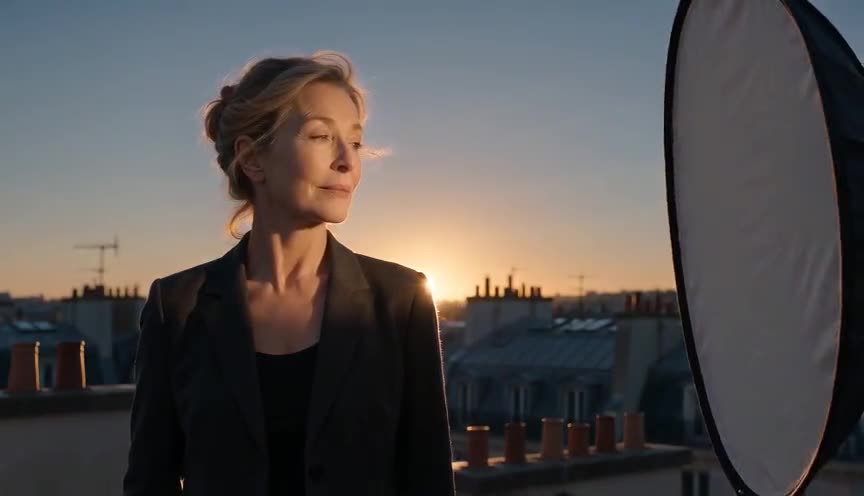
Fill light softens the shadows the key creates and lowers contrast; it never competes with the key in intensity or direction, and a scene can have a strong key with little or no fill for a harder look.
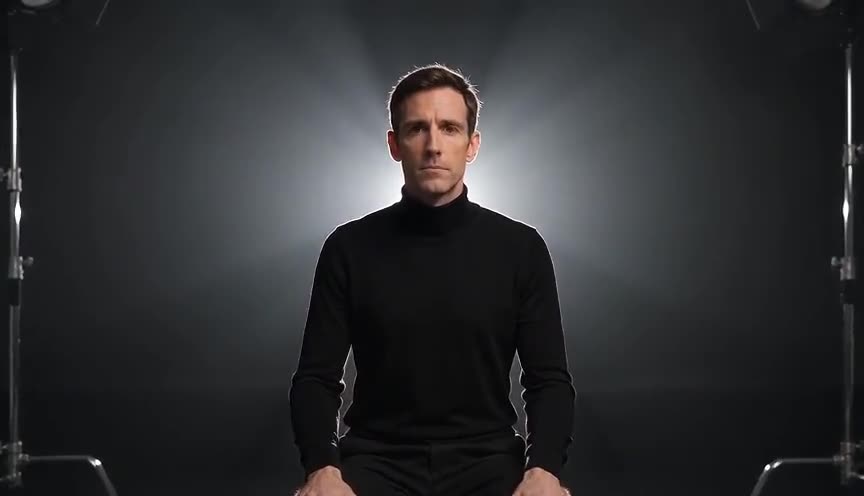
Three-point lighting is the full system (key, fill, backlight) built around the key as its foundation; key light alone describes only the dominant source, not the whole setup.
In film
The Godfather (1972)
Gordon Willis places the key light directly overhead, throwing eyes into shadow to make characters unreadable and menacing.
Citizen Kane (1941)
Gregg Toland uses a hard, low key light in several scenes to sculpt deep, expressive shadows across faces and rooms.
The prompt
Name the key explicitly: describe its source (window, lamp, sun through an opening), its angle relative to the subject, and whether it is hard or soft. Say what it does not do, such as no fill lifting the shadow side, so the model does not flatten the contrast. Avoid vague words like dramatic lighting; instead specify angle in degrees, distance, and one clear shadow result on the face or body.
The exact prompt that rendered the video on this page. Keep the description of the move, change the subject and the setting.
Key light: in an abandoned train station, one adult woman stands beside a rusted ticket booth as a single hard light source, a shaft of late afternoon sun through a broken skylight, strikes the left side of her face at a 45 degree angle, carving deep shadow across her right cheek and jaw. The camera stays locked on a static tripod, 50mm lens, as dust drifts through the beam. No fill light lifts the shadow side, no other source competes, the rest of the station remains in near darkness. She turns her head slowly toward the light, shadow sweeping across her features in real time. No text.
Common mistakes
Flat, shadowless faces
Placing the key too close to the lens axis kills the shadow that gives a face shape, leaving a flat, TV-commercial look instead of dimension.
No motivation for the source
A hard, directional key with no visible window, lamp or sky in frame reads as artificial and breaks the illusion of a real space.
Fighting fill with fill
Adding too much fill light erases the ratio between key and shadow, flattening contrast and losing the mood the key was set up to create.
Frequently asked questions
What is a key light in film?
The key light is the main light source in a shot, the one that sets direction, intensity and the primary shadow pattern on a subject before fill or backlight are added.
How is a key light different from a spotlight?
A spotlight is a specific fixture that produces a narrow, hard beam; a key light is a role, the dominant source in a lighting setup, which can be a spotlight, a window, a lamp or a soft panel.
What ratio should key and fill light have?
There is no single correct ratio; 2:1 gives a naturalistic, gently modeled face, while 8:1 or higher pushes toward hard, dramatic contrast with deep shadow on one side.
Can an AI video model generate accurate key lighting?
Yes, tools on Imaginode can render convincing key light when you describe the source, its angle and hardness explicitly, since vague terms like moody lighting tend to produce inconsistent results.