Over-the-shoulder shot
Also calledOTS shot, Over-shoulder framing, OTS
The over-the-shoulder shot frames one person from behind, showing part of their head and shoulder in the foreground while a second person faces the camera in the middle distance. It puts the viewer physically inside a conversation, aligned with one character's spatial point of view.
What it tells
Directors use the over-the-shoulder shot to root the audience in a specific listener's perspective during dialogue, making an exchange feel intimate and spatially real rather than abstract. Because we see the back of one head, we read the scene as if we too were standing close, watching the other person react. It builds tension in negotiations, warmth in reunions, and lets an editor cut cleanly between two matching angles without ever losing the geography of who is talking to whom.
How it is shot
Position the camera behind and slightly to the side of Person A, low enough to catch the curve of their shoulder and the edge of their head in the foreground, usually on the left or right third of the frame. Angle toward Person B, who sits in the middle or far third, facing camera at roughly eye level. A 50mm or 85mm lens compresses the space and keeps both figures readable while the foreground shoulder falls soft with a wide aperture, f/2.8 or wider. Shoot a matching reverse angle from behind Person B for the cut. Keep headroom consistent and match focal length and height on both setups so the pair reads as one continuous space.
When to use it
- Filming a dialogue scene where the audience needs to feel physically present inside the conversation.
- Building tension in negotiations, interrogations or confrontations where power shifts between two people.
- Cutting between two characters while preserving spatial continuity and eye-line direction across the scene.
- Softening exposition scenes by giving flat dialogue a sense of intimacy and physical proximity.
Not to be confused with
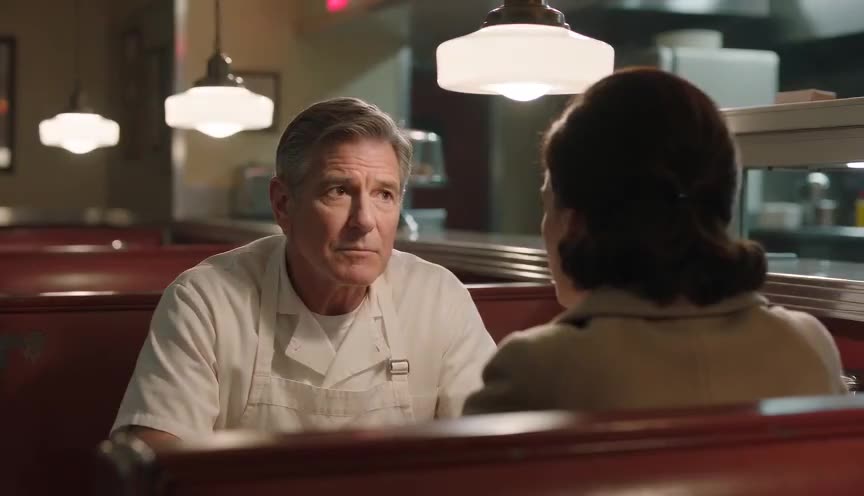
A reverse angle simply flips the camera to the opposite side of the same action and can be any framing size. The over-the-shoulder shot specifically keeps a foreground shoulder in frame to anchor point of view.
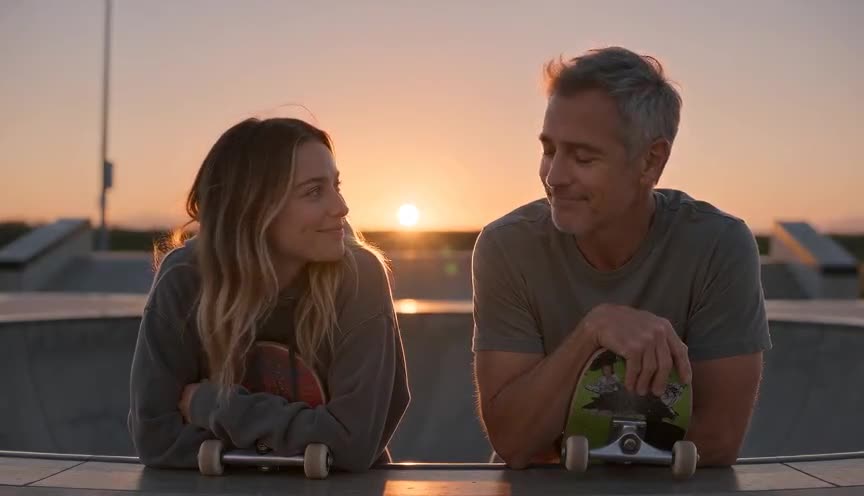
A two-shot places both people fully in frame at similar size and distance, favoring composition over point of view. The over-the-shoulder shot instead favors one character's perspective, pushing the other partly out of frame.
In film
The Godfather (1972)
Coppola uses tight over-the-shoulder framing in Vito's office and the restaurant meeting to make negotiations feel like physical confrontations.
Heat (1995)
Michael Mann shoots the diner conversation in alternating over-the-shoulder setups, letting the audience feel each man sizing up the other.
The prompt
Name the technique directly and describe which character's shoulder blocks the foreground, since models often default to a flat two-shot otherwise. Specify lens (50mm or 85mm), a shallow depth of field so the foreground shoulder falls soft, and keep the camera static or on a very slow creep, never a full pan. Avoid asking for both faces to be sharp at once, that reads as a two-shot, and avoid crowding the frame with a third person, which breaks the one-on-one point of view the shot depends on.
The exact prompt that rendered the video on this page. Keep the description of the move, change the subject and the setting.
Over-the-shoulder shot at a fishing harbor at dawn: the camera is positioned close behind a middle-aged man's left shoulder and the back of his head fills the lower left of the frame, soft and slightly out of focus, an 85mm lens holding shallow depth of field. In the middle distance, in sharp focus, a young woman in a rain jacket stands on the dock facing him, gesturing toward the moored fishing boats as pale gray light and low mist sit over the water. The camera holds almost still, drifting a few centimeters forward, gulls crossing behind her in soft focus. No text.
Common mistakes
Both faces sharp
Keeping both faces in equally sharp focus turns the shot into a two-shot and kills the sense that we are seeing through one character's point of view.
Foreground shoulder too large
Letting the foreground shoulder and head fill more than a third of the frame crowds out the other actor and reads as an accidental obstruction, not a deliberate frame.
Mismatched reverse angle
Shooting the reverse angle at a different height, lens or distance breaks the geography of the scene, so the cut feels like two different rooms instead of one conversation.
Frequently asked questions
What is an over-the-shoulder shot?
It is a framing where the camera sits behind one person, showing part of their head and shoulder in the foreground while a second person faces camera in the middle distance, used mainly in dialogue scenes to anchor the audience in one character's viewpoint.
Why do directors use over-the-shoulder shots in dialogue scenes?
They give conversations a sense of physical space and intimacy, let the audience read reactions on the facing character's face, and provide a clean, matched pair of angles for editing back and forth without confusing the viewer about who is speaking to whom.
How far should the actors stand from the camera in an OTS shot?
Close enough that the foreground shoulder reads clearly at the edge of frame, typically an arm's length or less from the lens, while the facing actor sits far enough back, often six to ten feet, to stay in comfortable medium or medium close-up range.
Can AI video tools generate an over-the-shoulder shot accurately?
Yes, if you describe the foreground shoulder, the lens, and the shallow focus explicitly, since the model has no camera to physically place. Tools like those on Imaginode respond well when the prompt states exactly which shoulder blocks the frame and which face stays sharp.