The self-published author
A self-published novelist puts a bookplate with her name in the copies she sells at book fairs or posts to reviewers. The motif borrows from her cover, a lighthouse for a novel set on an island.
Two square bookplates with your name written letter for letter, a lighthouse engraving or a fern wreath, to print on sticker paper. Workflow visible here, no account needed.
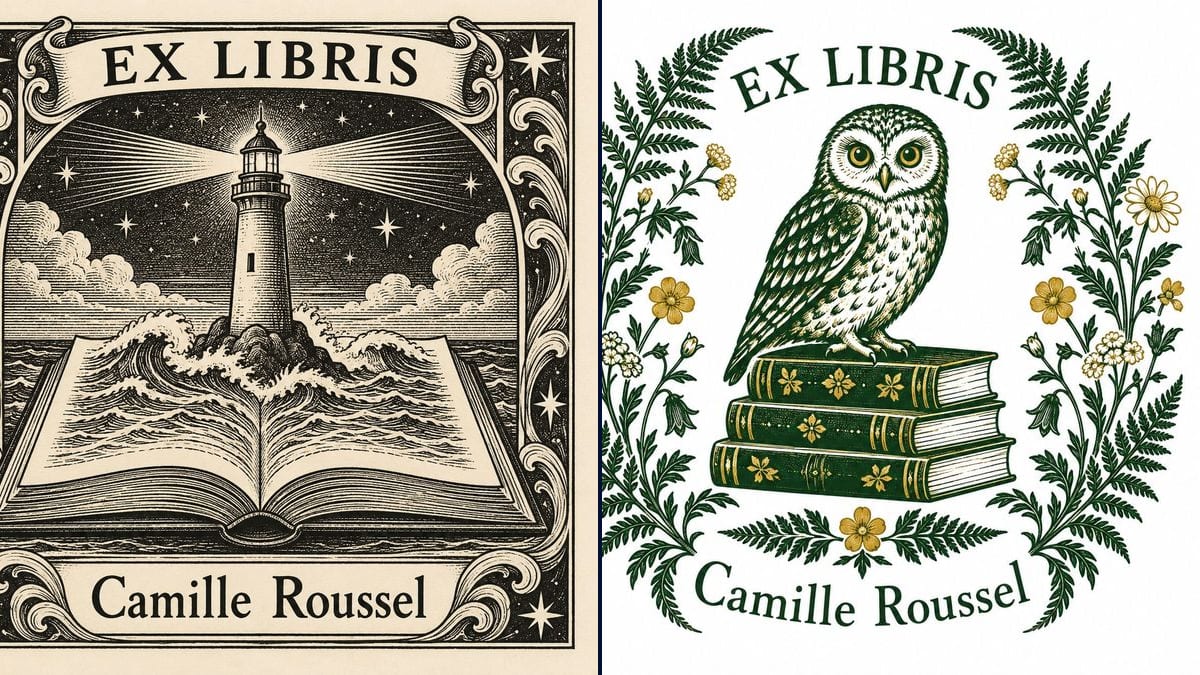
Real workflow: two bookplates for Camille Roussel, one in black ink on cream paper with a lighthouse rising from an open book in the waves, the other in green and gold with an owl on three books inside a wreath of ferns.
At a glance
A bookplate is the small label pasted inside the front cover that says whose book it is. Readers who lend a lot want one, and so do authors, for the copies they sign at fairs or send out to reviewers. Shop-bought ones all seem to have the same owl, and a custom engraving means finding an engraver and waiting. This workflow gives you two square bookplates with your name on them, ready to print.
The hard part is the name. A bookplate with one wrong letter is useless, and a model left to itself happily adds a motto or a date. The prompt gives the only two lines in quotes and describes the motif in a sentence. Sunburst spells them right and draws a convincing engraved line on cream paper, for three credits a label.
For the book itself, see the book cover; for something to slip between the pages, the custom bookmark. Both bookplates cost six credits.
These are the files of the workflow above, exactly as the models produced them, unretouched. The starting point is shown when there is one.
Render
Authors marking their signed copies, readers who lend their books, families giving a child a library, community lending libraries.
The name to write in quotes, the central motif in one sentence and the style: black engraving or two colour print.
Write the name
Exactly as it should appear: first and last name, surname only, or "From the library of …". In quotes, on the bottom line.
Pick the motif
One simple picture that says something about the reader or the book: a lighthouse, an owl, a cat, a quill, a tree. A single subject, in the centre.
Keep it to two lines
"EX LIBRIS" at the top, the name at the bottom. You can add a motto in quotes, but every extra line makes the name smaller.
Print it small
A bookplate is 6 to 9 centimetres across. Use matte sticker paper, or good paper and an acid-free glue for books that matter.
The same canvas, tuned for different needs: each variation is two or three lines of prompt away.
A self-published novelist puts a bookplate with her name in the copies she sells at book fairs or posts to reviewers. The motif borrows from her cover, a lighthouse for a novel set on an island.
She lends novels to colleagues and rarely sees them again. An engraved bookplate inside the front cover reminds everyone, without a word, where the book has to go back to.
A godmother gives the baby a first library: ten picture books, each with a botanical bookplate in the child's name. The owl on the pile of books wins the parents over and will last for years.
A neighbourhood group sets up a small lending library. A bookplate with the group's name, printed in black on sticker paper, marks every donated book before it goes out.
Two book collections move in together. A bookplate with both names goes into the books they buy together from now on, and each keeps their own for the old ones.
He buys first editions from antiquarian dealers and wants to mark them properly. He hands the image to an engraver for a real intaglio print, pasted inside the cover with wheat starch paste.
Name, motto, address, year: the bookplate becomes unreadable once shrunk to 8 centimetres. Two lines, three at most.
A whole landscape with a castle, a forest and a ship turns to mush at small sizes. One clear central subject, with room around it, reads well inside a cover.
On screen, the engraved line looks fine and crisp; at 6 centimetres it can fill in. Print a test on plain paper before you order sheets of labels.
On a valuable book, acidic glue stains the paper over the years. Use acid-free labels or starch paste, and the inside front cover rather than the title page.
In the demo, yes: "EX LIBRIS" and "Camille Roussel" are exact on both labels. Always check yours, especially if it has an accent or a hyphen.
Yes: add a line in quotes, such as "Please return me", and say where it goes. Keep it short, it will print very small.
No, it's an image that imitates the engraved line. For a copper plate or a rubber stamp, the image is a reference for the craftsperson, who redraws it by hand.
Six credits, three per label on GPT Image 2.5 Sunburst at medium quality. A third version, with another motif or a friend's name, costs three more.
Because it spells correctly on a light background, cream paper included, and it's the cheapest model in the catalogue. For a label where everything fits in two lines, that's all you need.
The render is square, 1254 x 1254 pixels, roughly 10 centimetres across at 300 dpi. That's enough for a 6 to 9 centimetre bookplate, the usual size.
Not directly: the gold in the demo is flat ochre yellow. For hot foil stamping, the printer needs one vector file per colour, redrawn from the image.
For your own designs, yes, as long as you check the terms: see the commercial use rules. Don't copy the signature style of a living engraver.
Design a custom bookplate with AI
Use this workflowFree account, no card required. The workflow opens pre-filled in your canvas.
 GPT Image 2.5 Sunburst
 Nano Banana 2.1
 Recraft V4.1