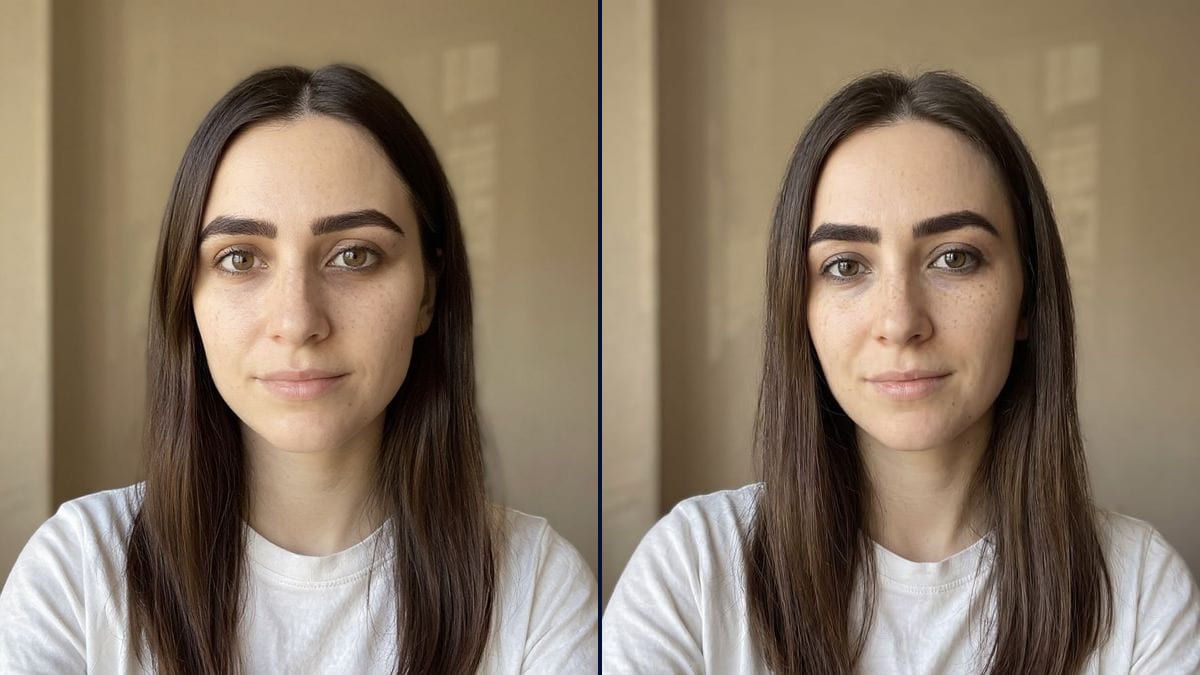
Before microblading
Her brows have been sparse since her teens and she is unsure about committing for two years. She compares an arch and a straight brow on her portrait before booking the mapping session.
Your portrait with arched microblading-style brows, then straight brushed-up laminated brows. Know what to ask for before the appointment. Workflow visible here, no account needed.
Real workflow: a portrait of a woman with long brown hair and thin brows, no make-up, in a white t-shirt, then the same woman with softly arched brows and with fuller straight brows. The brows come out thicker than the original.
At a glance
Microblading lasts one to two years, a lamination a few weeks. Before sitting in the chair, most people show the brow artist a photo from Instagram, on a face that isn't theirs. This workflow tries two shapes on YOUR portrait: a defined arch and a straight brow brushed upwards.
The hard part is changing the brows without retouching the whole face. The model tends to thicken, darken and add eye make-up along the way. The prompt says only the brows change, rules out make-up and gives a thickness. Flux Kontext mostly sticks to the area, but the demo shows what still gets past it.
For a full look, chain it with the make-up try-on or eye colour. Both shapes cost twelve credits.
These are the files of the workflow above, exactly as the models produced them, unretouched. The starting point is shown when there is one.
Starting point
Render
Women planning microblading or lamination, brow artists and brow bars showing a shape before they do it.
A front-facing portrait without make-up, forehead clear, and the shape, treatment and thickness of brow to try.
Take a front-facing portrait
Forehead clear, no fringe over the brows, no make-up, soft light. Look straight into the lens.
Name the shape
Arched, straight, rounded, angular, plus the treatment you have in mind: microblading, lamination, a simple shaping. The treatment word steers the result.
Hold the model back
Keep "only the eyebrows change, no makeup" and a thickness: "about the same as now". Without it, the model overdoes it.
Bring the picture to the appointment
The brow artist sees the target shape on your face and tells you what your hair and skin will really allow.
The same canvas, tuned for different needs: each variation is two or three lines of prompt away.
Her brows have been sparse since her teens and she is unsure about committing for two years. She compares an arch and a straight brow on her portrait before booking the mapping session.
At the salon, the artist photographs the client and shows two shapes on her own face. The conversation is about a shared picture, not words like "natural" or "bold".
Brushed-up brows are all over social media. Before paying for a session, she checks whether the style suits her or whether a classic shape looks more like her.
Years of over-plucking, and now she wants to let them grow. A picture of fuller brows on her own face helps her get through the weeks when nothing looks right and the tweezers are tempting.
Her brows fell out during treatment. Before cosmetic tattooing, she and the practitioner look at which shape best recalls her face from before, starting from a recent photo.
A brow bar shows its services on one portrait, shape by shape, so clients can choose on the website before booking rather than in the chair, with less time spent explaining at the start.
Without a rule, Kontext adds shadow around the eyes. Even with one, the demo brows come out thicker than the original. State the thickness and write "no makeup".
Hair falling over the brows hides part of them and the model invents the rest. Tie or push the hair back for the photo.
Pencil, powder or gel already in place blends with the new shape. Start from a bare face to judge the shape on its own.
The picture shows a look. The real outline is measured on the face, with a calliper or mapping string, by the practitioner.
It should stay the same, and the prompt asks for that. In the demo the skin and freckles stay, with no make-up, but the face is slightly slimmer: look at the picture with that in mind.
Yes: replace "the same dark brown as her hair" with the shade you want, such as light brown, ash blonde or taupe.
Yes, that is where the try-on helps most. Describe the thickness you expect: even when asked for "about the same", Kontext thickens them a little.
Twelve credits, six per render on Flux Kontext. A third shape on the same photo costs six more.
Because it edits one area and keeps the portrait, rather than redrawing the whole face. With brows it still spills over onto the features a little, so the prompt has to hold it back.
Kontext plays it safe when told to change nothing else: in the demo the "straight" brows keep a slight arch and aren't brushed up. For a clearer difference, describe the shape more boldly, such as "an almost horizontal line, hairs brushed upwards".
Not necessarily. Pigment depends on skin, healing and the practitioner's hand. The picture gives the shape to aim for.
The format of your photo, here 3:4. A vertical portrait framed on the face shows the brows best.
Try a new eyebrow shape on your photo with AI
Use this workflowFree account, no card required. The workflow opens pre-filled in your canvas.
 Flux Kontext
 Nano Banana 2.1
 GPT Image 2.5 Sunburst