The dystopian short
A director shoots in an underground car park that has to pass for a city under control. Six posters from the same ministry pasted on the pillars establish the regime from the first shot.
Two posters from inside your film's universe, a dystopian propaganda poster and an art deco travel poster, to dress the walls of your set. Workflow visible here, no account needed.
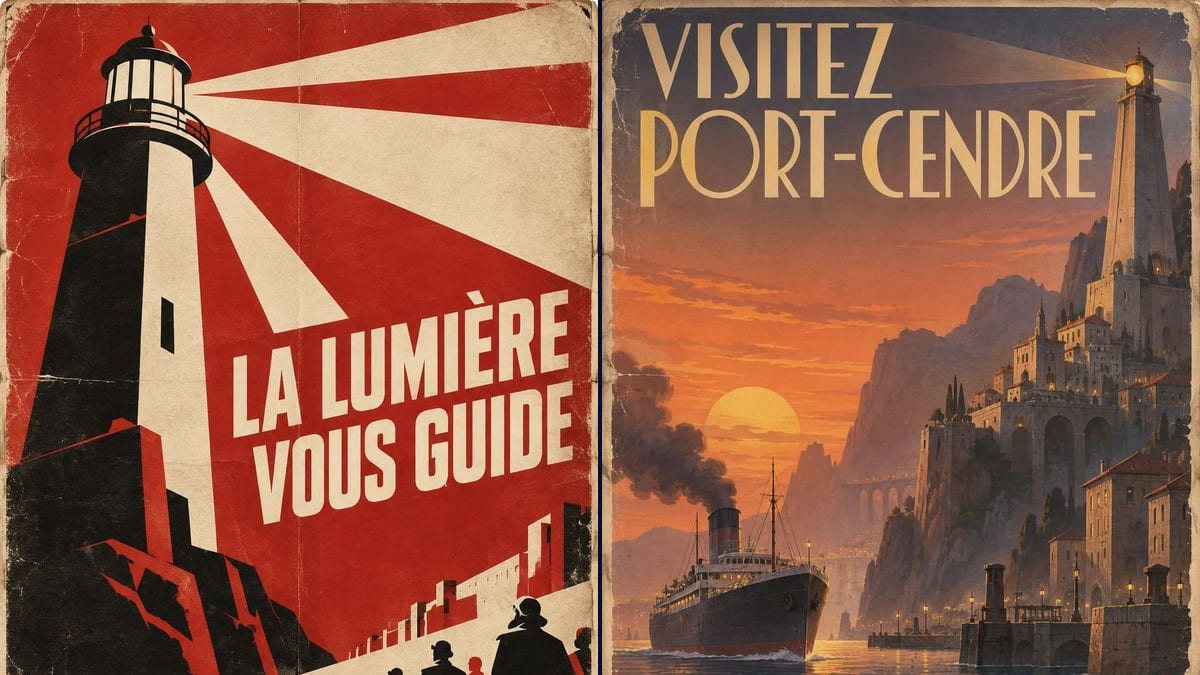
Real workflow: a red, black and cream constructivist poster "LA LUMIÈRE VOUS GUIDE" with a lighthouse and a line of citizens, then an art deco poster "VISITEZ PORT-CENDRE" with a liner arriving at sunset below a cliffside city. Both are in French.
At a glance
An invented world tells its story through its walls too. A dystopian street with no official posters, or a fantasy station with no travel ads, and the set feels empty. The audience only half reads them, but they say who's in charge and where people travel. This workflow gives you two: a constructivist propaganda poster and an art deco travel poster.
The hard part is that they have to come from inside the world. No film title, no cast, no release date: a ministry, a company, a slogan. The prompt gives the source, the period style and two lines of text in quotes. Sunburst writes them letter for letter.
For the poster that sells the film itself, use the poster maker; to dress the rest of the set, see turning a place into a period set. Both posters cost six credits.
These are the files of the workflow above, exactly as the models produced them, unretouched. The starting point is shown when there is one.
Render
Production designers, props teams, directors, fantasy and science fiction authors, AI filmmakers and role-play organisers.
Who made the poster in your world, the period style you want, and the slogan and signature in quotes.
Say who made the poster
A ministry, a shipping line, a brand from your world, a party. That source sets the tone and the bottom line.
Pick a period style
Constructivism, art deco, 1950s advertising: a familiar style reads at once as old and official, even in an invented world.
Two lines at most
A big slogan and a signature at the bottom. A street poster is read in passing, and that's how the audience sees it too.
Print and age it
A3 or larger after the Enhance node, then paste it up, crumple it, tear a corner. The worn paper in the prompt helps; real weathering does the rest.
The same canvas, tuned for different needs: each variation is two or three lines of prompt away.
A director shoots in an underground car park that has to pass for a city under control. Six posters from the same ministry pasted on the pillars establish the regime from the first shot.
A fantasy author shares documents from her world on her website. The port city's travel poster goes with the chapter where her heroine lands, and doubles as artwork to announce the release.
An AI filmmaker wants consistent walls from one shot to the next. She generates the posters first, then feeds them in as references so the streets of her city keep the same slogans.
A LARP group runs a game inside an old fort. The ministry posters, printed at A2 and pasted along the corridors, pull the players into the regime before the first briefing.
The production designer on "LIGNE DE NUIT" prepares ads for the series' metro platforms. Each season a new campaign replaces the old one, and the old posters stay half torn off.
A theatre company stages a play that moves from a free city to an occupied one. Between acts, the travel posters disappear under the propaganda, in full view of the audience.
A poster on the set belongs to the world, not the marketing. A film title or an actor's name breaks the illusion and reminds the audience they're watching a film.
A propaganda or travel poster is a slogan and a signature. Beyond that, the model is more likely to slip, and nobody reads it on screen anyway.
Reusing a famous real poster, with its symbols, raises both rights and meaning issues. Borrow a period style, invent the institution and the slogan.
On a set wall, a pristine poster reads as a prop. Ask for worn paper and add real weathering when you paste it up.
In the demo, yes: "LA LUMIÈRE VOUS GUIDE", "Ministère de la Clarté", "VISITEZ PORT-CENDRE" and the shipping line are exact, accents and middle dot included.
Yes: keep the style and the signature, change the slogan and the picture. Three or four variations of one campaign make a street believable.
Yes: swap the ministry for the brand and the slogan for a tagline. For the brand's logo, see the fictional company logo.
Six credits, three per poster on GPT Image 2.5 Sunburst at medium quality. A third poster for the same wall costs three more.
Because it spells correctly, accents included, and it's the cheapest model in the catalogue. For a set that needs ten different posters, the cost stays low.
The render comes out at 2:3, 1024 x 1536 pixels. For a wall poster at A2 or larger, run it through the Enhance node, and see how to enlarge an image for print.
Almost. On the dystopian poster, the citizens aren't tiny: the line grows towards the foreground. It still works, but for very small figures, write "all the citizens tiny, far below".
A style, yes: constructivism, art deco, railway posters. Not a specific real poster or its symbols: invent the institution, the slogan and the picture.
Make a poster from inside your film's world with AI
Use this workflowFree account, no card required. The workflow opens pre-filled in your canvas.
 GPT Image 2.5 Sunburst
 Nano Banana 2.1
 Recraft V4.1