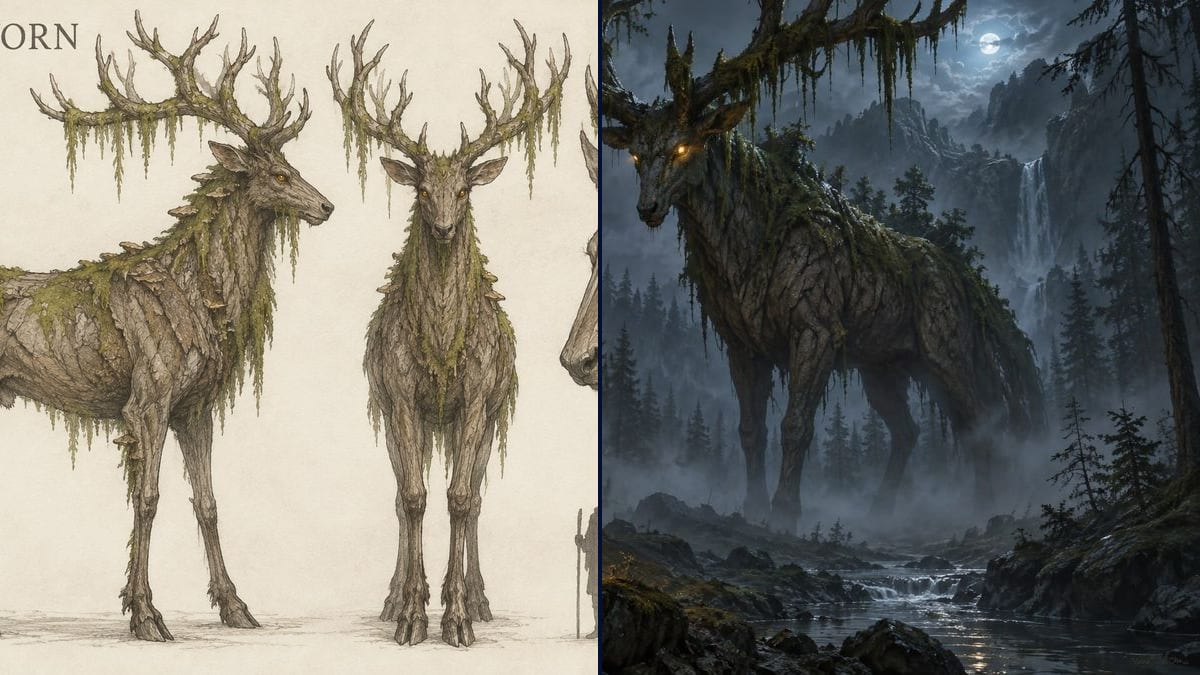
The creature from your novel or film as a side, front and head-study sheet with its height, then in its forest at night. Workflow visible here, no account needed.
Real workflow: the Cervorn, a deer-like beast with mossy antlers and bark skin, in side and front views and a close-up of its amber-eyed head, then standing in a misty pine forest facing a traveller with a lantern. The 3.5 m mark measures the human silhouette, not the beast.
At a glance
You provide
a text or a brief
What the workflow produces
2 images in 4:3
Canvas structure
5 nodes wired by 2 connections
Models wired in
GPT Image 2.5 Sunburst
Cost of one full run
about 6 credits, roughly $0.07
Account
The demo is visible without an account; generating requires a free account, trial credits included
The creature is often the scene readers wait for in a fantasy story, and the hardest one to describe without a pile of adjectives. The author knows what they see; the illustrator, makeup artist or 3D artist who takes over only has a rough idea. This workflow draws YOUR creature twice: as a design sheet to see how it's built, then in a scene to feel what it does to the people who meet it.
The hard part is scale as much as consistency. Sunburst keeps the same beast from one image to the next and spells the name and measurement right, but it doesn't tie the measurement to what it measures: in the demo, the 3.5 m belongs to the human silhouette. The prompt has to say where the mark goes and what it measures.
These are the files of the workflow above, exactly as the models produced them, unretouched. The starting point is shown when there is one.
Render
The Cervorn in pencil and watercolour, side and front views and a head study, mossy antlers, bark skin and amber eyesGenerated with GPT Image 2.5 SunburstThe same beast standing in a misty pine forest at night, amber eyes glowing, facing a traveller with a lanternGenerated with GPT Image 2.5 Sunburst
Who it is for
Fantasy and horror novelists, directors and VFX teams, makeup artists, AI filmmakers, game masters.
Which files to provide
A base animal, three strong traits, the height and what it measures, and the setting for the scene.
How it works
1
Start from a real animal
"Deer-like", "close to a wolf": the model gets an anatomy to lean on, and the creature stands up properly.
2
Add three strong traits
Mossy antlers, bark skin, amber eyes: three signs you'll find in every view. Beyond that, the beast turns into a collage.
3
Say what the mark measures
"A vertical 3.5 m measurement beside the beast's side view, from hoof to antler tip." Without that, the model measures whatever it likes.
4
Check the scene
The beast's size against the traveller, and the corners of the image: in the demo, a fake signature sits bottom right.
Variations and use cases
The same canvas, tuned for different needs: each variation is two or three lines of prompt away.
The fantasy novelist
The Cervorn shows up three times in his novel, always at night. He writes the first encounter with the sheet in front of him, and the description picks up details he wouldn't have found: the fungus on the bark, the moss hanging from the antlers.
The short film and VFX
The director is planning a creature shot in visual effects. The sheet goes to the 3D artist as a shape reference, and the scene gives the compositor the light and mood she's after.
The makeup artist and the prosthetic
On a low-budget short, the creature will be an actor in costume and prosthetics. The head study is where the sculptor starts, adapting the proportions to a human face.
The world's bestiary
An author is putting together a bestiary of her world for readers. One sheet per creature, all in the same pencil and watercolour style, and the collection reads like a naturalist's notebook.
The AI filmmaker
He's making a fully generated short with a creature in four shots. The sheet is his reference for keeping the same beast across shots, and the scene becomes the starting frame of the first video shot.
The tabletop campaign
The game master is preparing the encounter that ends the campaign. He shows the scene as the lantern lights up the beast, and keeps the sheet to describe what the players see next.
Common mistakes
Not saying what the mark measures
In the demo, "hauteur 3,5 m" sits against the human silhouette and measures it. Say the mark goes beside the beast, from the ground to the top of the antlers.
Piling on traits
Antlers, wings, scales, tentacles and a scorpion tail: the model keeps half and changes the rest between views. Three strong traits are enough.
Describing it differently in each node
If the scene says "forest beast" and the sheet says "mossy deer", you get two creatures. Copy the same description, word for word.
Publishing without checking the corners
Even with "no text", the model can slip in a fake signature, as in the bottom right of the demo scene. Zoom in on the edges before sharing.
In the demo, yes: the French title "LE CERVORN" and "hauteur 3,5 m" next to the scale are exact. But the mark measures the human silhouette, not the creature.
Is it the same creature in both images?
Yes in looks: mossy antlers, bark skin, amber eyes and fungus on the body show up on the sheet and in the scene. The size changes, though: the beast in the scene is far taller than 3.5 m.
Does it work for a horror monster?
Yes: change the base animal, the traits and the light. Keep the same structure, a sheet on a light background, then a mood scene.
How much do the two images cost?
Six credits, three per render on GPT Image 2.5 Sunburst at medium quality. A second scene or a study of the legs costs three more.
Why GPT Image 2.5 Sunburst?
Because it spells correctly on a light background, here the name and the height, and it's the cheapest model in the catalogue. A creature takes several attempts to find, and each one costs three credits.
What output format?
The prompt asks for 4:3; in the demo both images came out at 3:2, 1536 x 1024, wide enough for the three views on the sheet.
Why a human silhouette on the sheet?
It's the creature design convention: without a reference, a 3.5 m beast and a 30 cm one look the same. The measurement still has to apply to the beast, which isn't the case in the demo.
Can I use the creature in my book or film?
Yes, for a creature you invented. See the rules on commercial use, and steer clear of anything too close to a famous creature.
 GPT Image 2.5 Sunburst
 Nano Banana 2.1
 Recraft V4.1