The props master in prep
He has forty props to find in three weeks. One sheet per hero prop, approved by the director, stops him hiring a deck lantern when everyone expected a hurricane lamp.
A design sheet for one of your film's props, as a technical drawing with views, exploded detail and material notes, or a realistic three-angle render. Workflow visible here, no account needed.
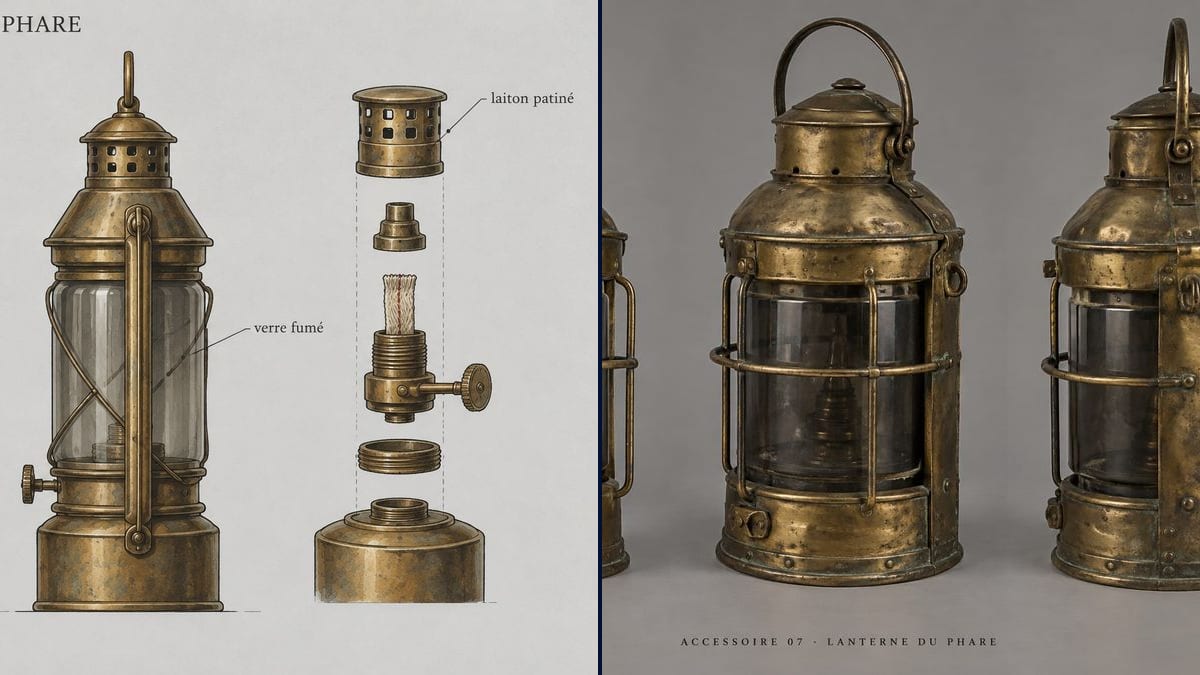
Real workflow: prop 07 of the fictional short "Le Dernier Train", the lighthouse lantern, drawn in brass from the front, the side and exploded with its 32 cm height, then a caged ship lantern photographed from three angles on grey.
At a glance
The breakdown says "lighthouse lantern" and everyone pictures something else. The director thinks of a hurricane lamp, the props master of a deck lantern, the production designer of something bigger. A prop sheet gets everyone to agree before anything is sourced, hired or built. This workflow gives you two: a technical drawing for the workshop and a realistic render for sign-off.
The hard part is a sheet that is actually useful, with several views and named materials. The prompt asks for front, side, exploded view and three exact notes, and Sunburst spells them right for three credits a sheet. One catch: each prompt is read alone, and in the demo the two lanterns aren't the same shape.
For paper props seen on screen, see the fake newspaper; for an unbranded product to dress the set, the greeked product. Both sheets cost six credits.
These are the files of the workflow above, exactly as the models produced them, unretouched. The starting point is shown when there is one.
Render
Props masters, production designers, directors, prop makers, theatre groups and AI filmmakers.
A precise description of the object, the views you want, three material or size notes and the prop number in quotes.
Describe the object precisely
Material, period, condition, shape: a caged brass ship lantern, smoked glass, dents and patina. The more precise the shape, the closer the two versions get.
Pick the views
Front and side for the silhouette, exploded for the mechanism that gets handled on camera: the wick, the latch, the lid.
Give the useful notes
Three at most, in quotes: material, finish, the dimension that matters for the frame. Add the prop number from the breakdown.
Sign off, then source
The director approves one sheet, and the props master takes it to the hire house, the flea market or the build workshop.
The same canvas, tuned for different needs: each variation is two or three lines of prompt away.
He has forty props to find in three weeks. One sheet per hero prop, approved by the director, stops him hiring a deck lantern when everyone expected a hurricane lamp.
The script calls for an engraved compass that drives the plot. The sheet is the starting point for the prop maker or the 3D printer, with the views and the material wanted.
The designer wants to know whether the lantern will hold its own on the lighthouse table in frame. The three-angle render helps choose size and patina before sourcing.
A creator watches his lantern change shape from one generated shot to the next. He approves one sheet, then feeds it in as a reference for every generation to keep the same object.
An author wants the central object of her novel to look the same on the cover and in the book trailer. The sheet fixes its shape for the illustrator and the editor.
A local theatre group has to build its own props. The exploded view shows how to make the lantern out of card and brass paint, piece by piece, light enough to carry across the stage.
"An old lantern" gets you a hurricane lamp one time and a ship lantern the next, as in the demo. Describe the cage, the handle, the top and the shape of the glass.
The demo drawing has one dimension, the height. The sheet shows intent; exact measurements come from the object you find or the workshop's plan.
If the actor lights the lantern on camera, the wick and lid matter. Ask for an exploded view of that part, not of a detail nobody will ever see.
Ten annotations and the sheet becomes unreadable, with more chances of a typo. Keep the material, the finish and the dimension that matters for the frame.
In the demo, yes: the French title and the three notes, "laiton patiné", "verre fumé" and "hauteur 32 cm", are exact, accents included.
No. The demo drawing only shows the height given in the prompt, and the proportions aren't measured. To build, the workshop draws a proper dimensioned plan.
Each node reads its own prompt, and "old brass ship lantern" leaves room. Describe the cage, the handle and the top in both, or keep only the version you prefer.
Six credits, three per sheet on GPT Image 2.5 Sunburst at medium quality. The next prop costs three more per version.
Because it spells notes correctly on a light background and handles a technical drawing as well as a product-style render. At three credits a sheet, one sheet per prop stays affordable.
Requested at 4:3, it came out at 3:2 in the demo, 1536 x 1024 pixels, a landscape A4 page for the props binder.
Not in this workflow, which starts from a blank page. If you've already found the object, photograph it: for continuity, a photo beats a sheet.
For a weapon, the sheet can show the look, but the real item goes through a film armourer and their rules. For a branded item, go for an unbranded version.
Make a film prop design sheet with AI
Use this workflowFree account, no card required. The workflow opens pre-filled in your canvas.
 GPT Image 2.5 Sunburst
 Nano Banana 2.1
 Recraft V4.1