The space opera novelist
His crew spends three books aboard the ARGO-7. He keeps the sheet pinned above his desk so the hold stops being at the bow in chapter twenty and at the stern in chapter thirty.
The ship from your novel or film as a three-view design sheet with its length, then in flight over a gas giant. Workflow visible here, no account needed.
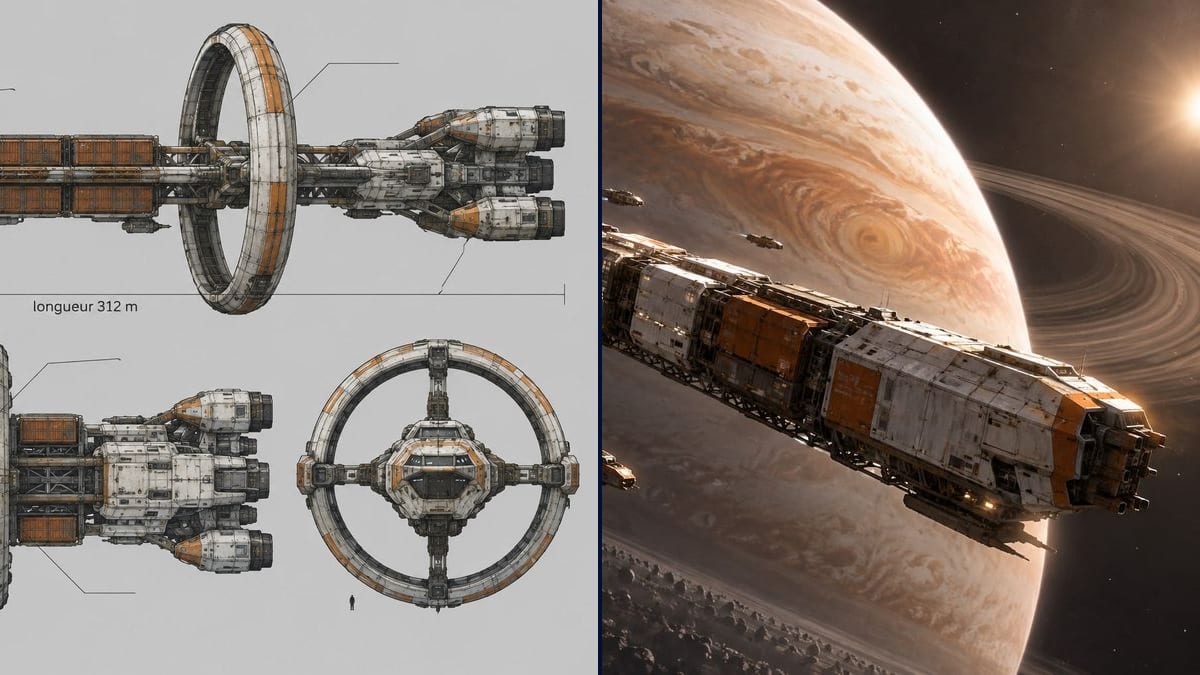
Real workflow: the cargo ship ARGO-7, worn white and orange hull and rotating ring, drawn in side, top and front views on grey with its 312 m length, then in flight before a gas giant surrounded by shuttles. The ring isn't in the same place in the side and top views.
At a glance
In science fiction, the ship is often the character that gets described most and seen least. The novelist knows where the bridge and the hold are, the screenwriter writes "the freighter enters orbit", and nobody else has a picture. This workflow draws YOUR ship twice: as a three-view design sheet to see how it's built, then in a scene to see what it says about the story.
The hard part is consistency and scale. Left alone, a model draws three different craft on one sheet and says nothing about size. The prompt asks for the same ship from three angles, a human figure and a written length. Sunburst spells the name and the measurement right, but its views don't line up like a real blueprint.
For whatever is waiting on arrival, see creature concept art; for the home port, the imaginary city. Both images cost six credits.
These are the files of the workflow above, exactly as the models produced them, unretouched. The starting point is shown when there is one.
Render
Science fiction novelists, writers of space series, directors of short and AI films, game masters.
The ship's silhouette, its colours and wear, its length in quotes, and the setting for the scene.
Describe the silhouette
Long, stubby, ring-shaped, winged: an overall shape and one or two standout features, like the rotating ring in the demo.
Give colours and wear
White and orange hull, worn panels, heat scoring. Copy the same description into both nodes so the sheet and the scene show the same ship.
Fix the size
A length in quotes and a human figure. Without both, readers can't tell a shuttle from a station.
Check the views
Make sure each feature sits in the same place in the side, top and front views. In the demo, the ring moved between two of them.
The same canvas, tuned for different needs: each variation is two or three lines of prompt away.
His crew spends three books aboard the ARGO-7. He keeps the sheet pinned above his desk so the hold stops being at the bow in chapter twenty and at the stern in chapter thirty.
The director is planning three VFX shots. The sheet goes to the 3D artist as a shape reference, and the scene becomes the lighting reference for the grade.
A writer developing a space series gives the ship a page of its own: sheet, length, crew size. Producers see straight away how big a set they'd have to build.
He's making a ten-minute fully generated film. The sheet keeps the ship consistent from shot to shot, and the scene becomes the starting frame of a video shot.
The game master shows the players the ship they've just salvaged. The printed three-view sheet also doubles as a map for placing characters during a boarding action.
A self-published author wants a ship on her cover. Before commissioning or generating the art, she settles shape and colours on the sheet, then shows the scene to the illustrator.
Without a human figure or a length, a 300-metre freighter and a 20-metre shuttle look alike. Give both.
"White and orange freighter" in one, "industrial ship" in the other, and the scene shows a different craft. Copy the same sentence.
Twenty technical callouts and the spelling mistakes pile up. Keep the title and length in the image, add the rest in layout.
The views don't line up to the millimetre: in the demo, the ring changes place. It's a design reference, not a modelling plan.
In the demo, yes: the French title "VAISSEAU ARGO-7" and "longueur 312 m" under the side view are exact. The callout lines stay blank, as the prompt requires.
Broadly, not in detail: hull, colours and engines agree, but the ring sits near the engines in the side view and amidships from above. For an exact plan you'll need an artist or a 3D model.
Yes, in another node: ask for a side cutaway with the bridge, the hold and the crew quarters. Keep the same hull description.
Six credits, three per render on GPT Image 2.5 Sunburst at medium quality. An interior cutaway or a second scene costs three more.
Because it spells correctly on a light background, here the name and the length, and it's the cheapest model in the catalogue. For a ship you'll redraw ten times before it's right, that matters.
16:9 requested, 1536 x 1024 in the demo. The sheet fits its three views, and the scene gets its widescreen feel.
Partly: feed the scene to a video node as the starting frame. For consistency across shots, see 3D previz to live action video.
Better to invent: a ship too close to a famous design causes trouble once you publish. Describe your own silhouette, colours and wear.
Design your story's spaceship with AI
Use this workflowFree account, no card required. The workflow opens pre-filled in your canvas.
 GPT Image 2.5 Sunburst
 Nano Banana 2.1
 Recraft V4.1