The costume designer on a short
She has three weeks and a small budget to dress six characters. One board per costume, shown to the director before buying anything, saves bringing back pieces that don't fit his idea of the film.
Your character's costume board, as a front and back illustration with swatches or as a photo flat lay of the pieces, fabrics spelled right. Workflow visible here, no account needed.
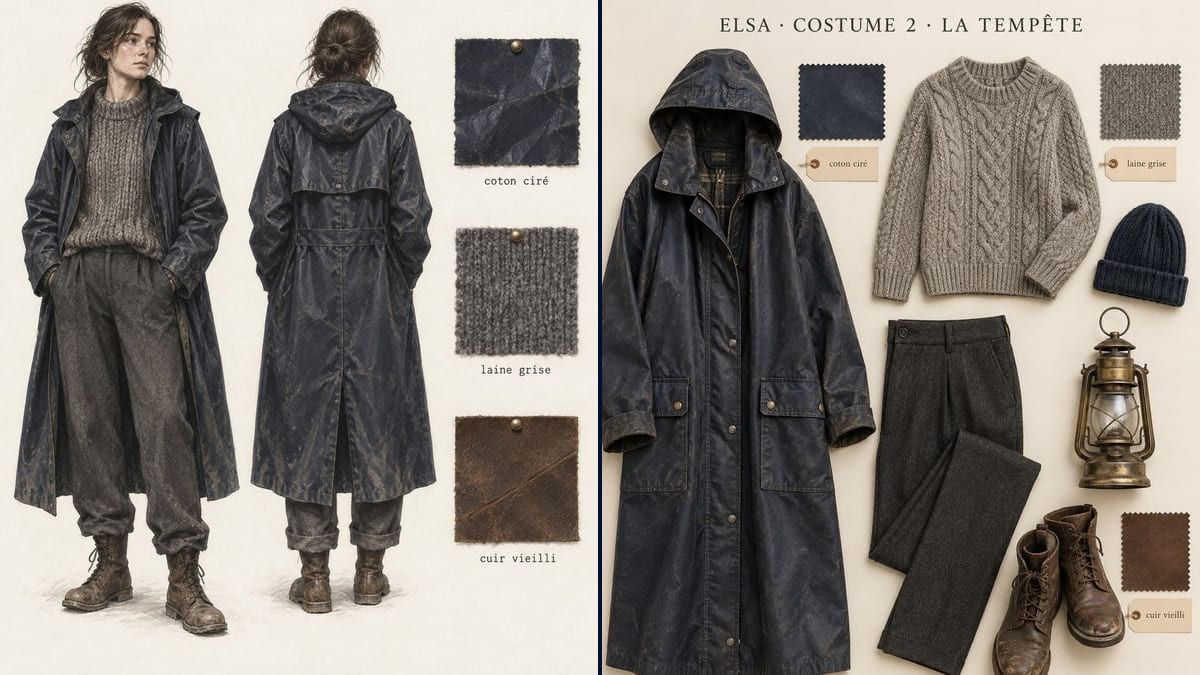
Real workflow: Elsa's costume 2 for the storm scene of the fictional short "Le Dernier Train", long navy raincoat, cable jumper, wool trousers and worn boots, drawn front and back with three pinned swatches, then laid flat with a beanie and a lantern.
At a glance
On a short film, the costume often gets decided in a charity shop the day before the fitting, and the director first sees the outfit when the actor walks out in it. A costume board moves that conversation earlier: the silhouette, the back, the fabrics, the costume number in the continuity. This workflow gives you two, an illustration for the prep binder and a photo flat lay to take shopping.
The hard part is making a board the costume team can use. The model has to name the fabrics without filling the page with fake notes. The prompt lists every piece, asks for the back view and restricts the text to the title and the labels. Sunburst gets every word right for three credits a board.
For the character's face, see the character sheets; to keep them identical from shot to shot, the consistent character. Both boards cost six credits.
These are the files of the workflow above, exactly as the models produced them, unretouched. The starting point is shown when there is one.
Render
Costume designers, costume standbys, directors, production designers, novelists and AI filmmakers who need to fix a character's outfit.
The costume pieces with colour and condition, three fabrics in quotes, the character's name and the costume number.
List the pieces
Garment by garment, with colour and condition: navy raincoat, cable jumper, wool trousers, worn boots. Add the prop the character carries in the scene.
Name three fabrics
The three that matter for the workroom or the shopping list, each in quotes. Any more and the labels start to overlap.
Title it like the continuity
Character name, costume number, scene or story moment. That is the title the costume standby will look for on the rail.
Bring it to the fitting
Printed or on a tablet, it is the reference for the designer, the director and the actor when the real outfit arrives.
The same canvas, tuned for different needs: each variation is two or three lines of prompt away.
She has three weeks and a small budget to dress six characters. One board per costume, shown to the director before buying anything, saves bringing back pieces that don't fit his idea of the film.
On a self-funded shoot, he handles costumes himself. The flat lay becomes his charity-shop shopping list and the reference for the actor, who brings some of her own clothes.
The costume standby tracks four changes for the same character. Each board carries the number and the story moment, and goes into the continuity folder next to the photos taken on set.
A self-published author wants to pin down her heroine's outfit for her cover illustrator. The board settles the raincoat, the jumper and the boots once and for all, colours and fabrics included.
A creator generates shots with the same character and watches the coat change cut with every prompt. The costume board becomes his reference, and the named fabrics go into every prompt.
A producer is putting together the pack for a period short. Two costume boards show the art direction is thought through, next to the mood board and the location photos.
"A sailor's outfit in a storm" lets the model choose every garment. List the pieces one by one, with colour and how worn they are.
In the demo, the handwritten notes never appeared because the prompt bans any other word. If you want "tartan lining" on the board, put it in quotes.
Eight swatches and eight labels and the board becomes unreadable. Keep the three fabrics that raise questions for buying or making.
On the demo illustration, the raincoat has a quilted diamond sheen no waxed cotton has. The board shows intent; the fabric gets chosen from a real swatch, in your hand.
In the demo, yes: the French title and the three fabric labels are exact on both boards, accents and middle dots included.
The illustration prompt asks for notes, then bans every word except the title and labels, and the model obeyed the ban. For real notes, write them in quotes.
Not in this workflow, which starts from a blank page. To try the outfit on a specific face, use the casting test.
Six credits, three per board on GPT Image 2.5 Sunburst at medium quality. The character's next costume costs three more.
Because it spells the title and labels right on a light background, accents included, and handles a fashion illustration as well as a photo flat lay. It is also the cheapest model in the catalogue.
Requested at 4:3, both demo boards came out in portrait, 1145 x 1374 pixels, like a classic costume board.
No. It shows the silhouette and the fabrics; measurements, cut and pattern are still the workroom's or the designer's job.
Yes: duplicate the node for each costume, keep the same board style and a numbered title. Three credits a board.
Make a film costume board with AI
Use this workflowFree account, no card required. The workflow opens pre-filled in your canvas.
 GPT Image 2.5 Sunburst
 Nano Banana 2.1
 Recraft V4.1